
Key takeaways
- Toasters for restaurants compared on verified slot size, shade control and build quality across seven models for busy kitchens and steady daily toasting today.
What's inside
As an Amazon Associate I earn from qualifying purchases. This post may contain affiliate links at no extra cost to you.
A restaurant morning moves in waves. Orders arrive together, bread needs to leave the kitchen in steady batches, and a toaster that works well for one or two slices at home can slow a whole line when it has to repeat the same cycle again and again. That gap is the heart of best toasters for restaurants as a search, and it is also the reason this guide stays plain about what the seven models below can and cannot do. Most of the models in this set are 2-slice home toasters. They were built for a kitchen counter at home, not for a restaurant line, and they should be read that way. The 4-slice models in the set offer more room per cycle, and that extra room matters when several orders need toast at the same time, yet they remain home toasters in build and in duty cycle. No model here should be read as a unit built for a restaurant line, and no model here should be chosen on the idea that a home toaster will behave like a high-volume unit simply because the keyword asks for it.
The useful question, then, is narrower and more honest. Which home toasters, used in a busy kitchen, give the steadiest browning from batch to batch, the widest slots for thick bread, the clearest shade control, and the easiest crumb-tray routine when the tray fills again and again? Those four points shape the whole comparison. Slot width decides whether thick slices, bagels, and English muffins fit without being squeezed at the edges. Shade control decides whether the first batch and the fifth batch look alike, and whether a cook can repeat a setting for the same bread day after day. Crumb-tray access decides whether cleaning stays quick between rushes or turns into a pause in the middle of service. Build and weight decide whether a toaster stays put on a counter, whether the lever feels solid after many lifts, and whether the unit can be moved for cleaning without a struggle.
This article compares seven models on those points, using only the figures that were seen on opened product pages and research files. Where sources conflict, the article says so directly instead of picking one figure and presenting it as settled. Where a figure was not stated, the article says the figure was not stated. Wattage conflicts, shade-count conflicts, dimension conflicts, and slot-width gaps are all noted in the product sections below, because a busy kitchen needs to know what is known and what is not known before a choice is made. A toaster that looks strong on one line can be weaker on another, and the table and the product sections are built to show that trade-off in the open.
The lead model is a 4-slice Cuisinart with two independent dials, and it leads because four slots change the rhythm of a busy morning more than any single feature on a 2-slice model. The next models alternate between 2-slice and 4-slice designs, and each one is judged on the same points: how many slices it toasts at once, how wide the slots are, how the shade control works, which functions the maker lists, how the crumb tray is reached, and what the maker states about warranty. The buying guide after the product sections turns those points into a short routine for choosing, and the FAQ answers the questions that come up most often when a home toaster is asked to do steady daily work in a busy kitchen.
Best Toasters for Restaurants Compared
| Model | Key Spec | Best For |
|---|---|---|
| Cuisinart 4 Slice Toaster, Compact Stainless Steel Toaster CPT-180P1 | 4 slices, 1800 watts, 6 shade settings, 1.5 inch slots, limited 3-year warranty | Four-slice batches with two independent dials |
| BLACK+DECKER 2-Slice Extra Wide Slot Toaster, Classic Oval, Black with Stainless Steel Accents TR1278B | 2 slices, 850 watts, shade count not settled, extra-wide slots with no numeric width stated, 2 year limited warranty | A compact 2-slice station where space is tight |
| Cuisinart 2-Slice Toaster, Compact (Compact Plastic Toaster), White CPT-122 | 2 slices, wattage not settled, 7 shade settings, 1.5 inch slots, limited 3 year warranty | Light 2-slice work with wide slots and a simple dial |
| Cuisinart CPT-160 Metal Classic 2-Slice Toaster, Brushed Stainless CPT-160P1 | 2 slices, 900 watts, 6 shade settings, 1.5 inch slots, warranty length not stated on the opened page | Steady 2-slice toasting in a metal body |
| KitchenAid 4 Slice Toaster with Manual High-Lift Lever KMT4115 | 4 slices, 1440 watts, 5 shade settings, 1.5 inch slots, warranty length not stated on the opened page | Four-slice batches with a manual high-lift lever |
| Hamilton Beach 2 Slice Extra Wide Slot Toaster with Bagel & Defrost Settings, Shade Selector, Toast Boost, Auto Shutoff, Black & Stainless Steel 22633 | 2 slices, 750 watts, 7 toast shades, extra-wide slots with no numeric width stated, one year warranty | Small breads and bagels with a lift for short slices |
| Breville 'A Bit More' Brushed Stainless Steel 2-Slice Toaster BTA720XL | 2 slices, 900 watts, 5 shades, slot width not stated as a number, 1-year warranty | A 2-slice station that needs a little extra time on demand |
How We Chose These Toasters
The set was chosen from a verified pool of pop-up toasters sold on Amazon US, and every figure in this article comes only from the research files for that pool. No figure was added from memory, and no figure was guessed to fill a gap. When the research files mark a figure as not verified or as in conflict, this article repeats that flag in plain words. That rule matters for a busy kitchen, because a wattage figure that conflicts across sources cannot be used to judge speed, and a dimension figure that conflicts cannot be used to judge counter fit. The article therefore leans on the figures that were settled: slice count, slot width where stated, shade settings where settled, listed functions, crumb-tray design, and warranty length where stated.
Slice count came first. A 4-slice model toasts twice as many slices per cycle as a 2-slice model, and that difference is felt at once when several plates need toast together. Dual independent controls mattered next, because two dials let a cook run two pairs at different shades in the same cycle, which is useful when one order wants light toast and another wants dark toast. The lead model and the KitchenAid 4-slice model both offer that kind of split control, and that is a large part of why they sit near the top of the set for busy use.
Slot width came next. A slot stated at 1.5 inches takes thick bread, bagels, and English muffins with room to spare, while a slot described only as extra-wide, with no numeric width stated, cannot be judged in the same way. This article does not treat a vague extra-wide label as equal to a stated 1.5 inch width. Four models in this set state 1.5 inch slots, and that stated width is a clear point in their favour for thick slices. The other models may still take thick bread, but the research files do not give a number, so the article does not claim one.
Shade control was judged on clarity and repeatability. A dial with a stated number of settings, and with light, medium, and dark ranges described by the maker, lets a cook return to the same setting day after day. A variable slider with a stated number of shades does the same work in a different form. Where the shade count conflicts, as it does for the BLACK+DECKER model, the article says the count is not settled and does not lean on it. Where the step count is not settled, as it is for some Breville models in the wider pool, the article says so, and for the Breville model in this set the research files state 5 shades through a variable browning control.
Functions were counted only when the maker lists them. Bagel, Defrost, Reheat, Cancel, Frozen, A Bit More, Lift and Look, and Toast Boost are all real functions on the models that list them, and each one changes how a cook works. A bagel function that browns one side only is useful for a bagel order. A defrost function is useful when bread comes from cold storage. A reheat function is useful when toast has cooled while a plate waits. A cancel function is useful when a cycle needs to stop at once. An A Bit More button is useful when a slice needs a little extra time without a full new cycle. None of these functions turns a home toaster into a unit built for a restaurant line, but each one removes a small friction from a busy routine, and the product sections name only the functions the maker lists for that model.
Crumb-tray design was judged on access and on how often the tray must be emptied. A slide-out tray at the back or side, a drop-down tray, and a removable tray all work, but they work differently when the toaster sits against a wall or in a tight corner. A 4-slice model fills its tray faster than a 2-slice model, because it toasts more bread per cycle, so tray access matters more on the larger models. The article names the tray type for each model where the research files state it, and it does not claim a tray type where the files do not state one.
Build, weight, and warranty were judged last, and they were judged as supporting points rather than as the main choice. A heavier metal body tends to stay put when the lever is pressed again and again. A lighter plastic body is easier to move for cleaning, yet it may shift on the counter. A stated warranty length gives a clear reference for the maker stand behind the unit, while a warranty length that was not stated on the opened page leaves that point open. The article states the warranty only where the research files state it, and it says plainly where the length was not stated.
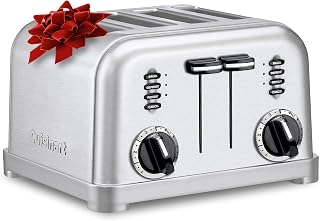
Cuisinart 4 Slice Toaster, Compact Stainless Steel Toaster CPT-180P1
- Slice count: 4 slices
- Wattage: 1800 watts
- Shade settings: 6 settings, with two independent dials, one per 2-slice pair
- Slot width: 1.5 inches, described as four extra-wide slots
- Functions listed: Bagel, Defrost, Reheat, Cancel
- Other features listed: dual independent toasting controls, high-lift lever, slide-out crumb tray, cord wrap
- Dimensions: 10.65 inches deep by 11.15 inches wide by 7.5 inches high
- Weight: 6.1 pounds
- Warranty: Limited 3-year warranty
- Discontinuation: the opened page stated the maker had not discontinued this model
This is the lead model because it is the clearest match for steady batch toasting in this set. Four slots at 1.5 inches each take four thick slices at once, and two independent dials let a cook set one pair light and the other pair dark in the same cycle. That split control is the feature that matters most when orders differ, because it removes the need to run two separate cycles for two different shades. The 1800 watt figure was stated on the opened page and in the maker comparison table on the same page, so it is presented here as stated. The 6-setting dials give a clear range to repeat, and the high-lift lever helps a cook lift short slices without reaching into a hot slot. The slide-out crumb tray is reached from the side, and the cord wrap keeps the cord tidy when the unit is moved for cleaning. At 6.1 pounds the metal body has enough weight to stay put on a counter during repeated use, and the limited 3-year warranty is stated in the product description. For a busy kitchen that needs four slices at a time, this model sets the pace for the set, and the other models are judged against its batch size and its split controls.
Pros: Four slices per cycle with two independent dials; stated 1.5 inch slots for thick bread; Bagel, Defrost, Reheat, and Cancel functions listed; slide-out crumb tray and high-lift lever; limited 3-year warranty stated.
Cons: Still a home toaster, not a unit built for a restaurant line; a 4-slice body takes more counter room than a 2-slice model; the crumb tray fills faster because more bread is toasted per cycle.
BLACK+DECKER 2-Slice Extra Wide Slot Toaster, Classic Oval, Black with Stainless Steel Accents TR1278B
- Slice count: 2 slices
- Wattage: 850 watts
- Shade settings: not settled, sources conflict on the opened page between 7 and 6
- Slot width: not verified as a number, described only as extra-wide
- Functions listed: Bagel, Frozen, Cancel
- Other features listed: extra-lift lever, drop-down crumb tray, self-adjusting bread guides, auto shut-off, cord wrap, blue LED indicators
- Dimensions: not settled, sources conflict and one figure looks like a listing error
- Weight: 2.54 pounds
- Warranty: 2 year limited warranty
- Voltage: the opened page lists 230 volts, which looks like a listing error for this US model, so voltage is not presented as settled
This is a 2-slice home toaster, and it should be chosen only for light 2-slice work, not for a full restaurant line. Its place in the set is as a compact station toaster, where counter room is tight and only one or two slices are needed at a time. The 850 watt figure was stated on the opened page, and the extra-lift lever helps with short slices. The drop-down crumb tray is a different design from the slide-out trays on the Cuisinart models, and it needs room below the front of the unit to open cleanly, so counter placement matters. Self-adjusting bread guides hold slices in the centre of the slot, which helps browning stay even across the face of the bread. The shade count is not settled, because the maker section, the listing title, and the product information on the opened page state 7, while the product description on the same page states 6. This article does not pick one of those figures. The slot width was not stated as a number, so this article does not claim a width for this model. The dimensions are also not settled, because the opened page and a retailer spec sheet give different figures, and one height figure looks like a listing error. At 2.54 pounds this is the lightest model in the set, which makes it easy to move, yet it also means the body may shift more easily when the lever is pressed. The 2 year limited warranty is stated in the item details.
Pros: Compact 2-slice body for a tight station; Bagel, Frozen, and Cancel functions listed; extra-lift lever and self-adjusting guides; drop-down crumb tray; 2 year limited warranty stated.
Cons: Only 2 slices per cycle, so batch toasting is slow; shade count not settled across sources; slot width not stated as a number; dimensions not settled; light body may shift on the counter.
Cuisinart 2-Slice Toaster, Compact (Compact Plastic Toaster), White CPT-122
- Slice count: 2 slices
- Wattage: not settled, sources conflict between 900 watts and 825 watts
- Shade settings: 7 settings, with settings 1 to 2 light, 3 to 5 medium, and 6 to 7 dark
- Slot width: 1.5 inches
- Functions listed: Bagel, Defrost, Reheat, Cancel
- Other features listed: high-lift lever, slide-out crumb tray, cord wrap
- Dimensions: not settled, sources conflict in format across opened pages
- Weight: 2.6 pounds
- Warranty: Limited 3 year warranty, stated on the opened retailer page
- Discontinuation: the opened page stated the maker had not discontinued this model
This is a 2-slice home toaster in a compact plastic body, and it should be read as a light-duty station toaster rather than as a unit for a restaurant line. Its strength is the combination of a stated 1.5 inch slot width and a clear 7-setting dial with light, medium, and dark ranges described by the maker. That combination lets a cook fit thick bread and repeat a shade setting with confidence, even though only two slices are toasted at a time. The wattage is not settled, because one opened source lists 900 watts and another field on the opened page lists 825 watts, so this article does not present a wattage figure for this model. The dimensions are also not settled, because the opened pages give the figures in different formats, so counter fit should be judged by the unit in hand rather than by a figure here. The slide-out crumb tray is simple to reach, and the high-lift lever helps with short slices. At 2.6 pounds the plastic body is easy to lift and move for cleaning, and the limited 3 year warranty is stated on the opened retailer page. For a busy kitchen this model works best as a second station, where one cook toasts a small order while the 4-slice models handle the larger batches.
Pros: Stated 1.5 inch slots for thick bread; clear 7-setting dial with light, medium, and dark ranges; Bagel, Defrost, Reheat, and Cancel functions listed; slide-out crumb tray; light body that is easy to move.
Cons: Only 2 slices per cycle; wattage not settled across sources; dimensions not settled; plastic body is light and may shift; not a unit built for a restaurant line.
Cuisinart CPT-160 Metal Classic 2-Slice Toaster, Brushed Stainless CPT-160P1
- Slice count: 2 slices
- Wattage: 900 watts
- Shade settings: 6 settings, with settings 1 to 2 light, 3 to 4 medium, and 5 to 6 dark
- Slot width: 1.5 inches
- Functions listed: Bagel, Defrost, Reheat, Cancel
- Other features listed: high-lift lever, slide-out crumb tray, cord wrap, LED indicator lights
- Dimensions: 7.13 inches deep by 10.75 inches wide by 7.13 inches high
- Weight: 4.8 pounds
- Warranty: length not stated on the opened page, so the warranty length is not presented here as settled
- Voltage: the opened page lists 230 volts, which looks like a listing error for this US model, so voltage is not presented as settled
- Discontinuation: the opened page stated the maker had not discontinued this model
This is a 2-slice home toaster in a brushed stainless metal body, and it is a steadier 2-slice choice than the lighter plastic models in the set. The 900 watt figure was stated on the opened page and in the maker comparison table on the same page, so it is presented here as stated. The 6-setting dial has a clear light, medium, and dark range, which helps a cook repeat a shade for the same bread. The stated 1.5 inch slots take thick bread without squeezing the edges, and the Bagel, Defrost, Reheat, and Cancel functions cover the common needs of a busy morning: a bagel browned on one side, bread from cold storage, toast that needs warming again, and a cycle that needs to stop at once. LED indicator lights show which function is active, which helps when several cooks share the same station. The slide-out crumb tray and cord wrap keep the routine tidy, and the high-lift lever helps with short slices. At 4.8 pounds the metal body stays put better than the lighter plastic models, which matters when the lever is pressed many times in a row. The warranty length was not stated on the opened page, so this article does not claim a length, and the voltage field on the opened page looks like a listing error, so voltage is not presented as settled. For a busy kitchen this model works as a solid 2-slice station, yet it still toasts only two slices at a time, so it cannot match the batch rhythm of a 4-slice model.
Pros: Stated 1.5 inch slots and 900 watts; clear 6-setting dial with light, medium, and dark ranges; Bagel, Defrost, Reheat, and Cancel functions listed; metal body at 4.8 pounds that stays put; LED indicator lights.
Cons: Only 2 slices per cycle; warranty length not stated on the opened page; voltage field on the opened page looks like a listing error; not a unit built for a restaurant line.
KitchenAid 4 Slice Toaster with Manual High-Lift Lever KMT4115
- Slice count: 4 slices
- Wattage: 1440 watts
- Shade settings: 5 settings, from 1 light to 5 dark
- Slot width: 1.5 inches
- Functions listed: Bagel button, Cancel button, with maker text stating the toaster can defrost and toast frozen food or reheat previously toasted food
- Other features listed: dual independent controls, manual high-lift lever, removable crumb tray, under-base cord storage, all-metal construction
- Dimensions: 11.4 inches deep by 11.62 inches wide by 7.48 inches high
- Weight: 7.2 pounds
- Warranty: length not stated on the opened page, so the warranty length is not presented here as settled
- Discontinuation: the opened page stated the maker had not discontinued this model
This is the second 4-slice model in the set, and it is the heaviest model in the set at 7.2 pounds. That weight, with all-metal construction, gives the body a solid feel on the counter, and the manual high-lift lever is a direct, hand-controlled lift that raises small slices clear of the slot. Four slots at 1.5 inches each take four thick slices at once, and dual independent controls let a cook run two pairs at different shades, which is the same split-control strength that the lead model offers. The 1440 watt figure was stated on the opened page, and the 5-setting shade control runs from 1 light to 5 dark, which is a shorter range than the 6-setting and 7-setting dials on the Cuisinart models, yet it is still clear enough to repeat. The bagel button reduces power on one side of the heating elements, so a bagel browns on the cut side while the outer side stays lighter. The maker text on the opened page also states the toaster can defrost and toast frozen food or reheat previously toasted food, and a cancel button is listed. The removable crumb tray is reached for emptying, and under-base cord storage keeps the cord out of the way. The warranty length was not stated on the opened page, so this article does not claim a length. For a busy kitchen this model is a strong second 4-slice choice, with a heavier body and a manual lever that some cooks prefer, yet it remains a home toaster and should not be read as a unit built for a restaurant line.
Pros: Four slices per cycle with dual independent controls; stated 1.5 inch slots; manual high-lift lever; all-metal construction at 7.2 pounds; bagel and cancel controls listed.
Cons: Only 5 shade settings, a shorter range than the 6-setting and 7-setting models; warranty length not stated on the opened page; a 4-slice body takes more counter room; still a home toaster, not a unit built for a restaurant line.
Hamilton Beach 2 Slice Extra Wide Slot Toaster with Bagel & Defrost Settings, Shade Selector, Toast Boost, Auto Shutoff, Black & Stainless Steel 22633
- Slice count: 2 slices
- Wattage: 750 watts
- Shade settings: 7 toast shades
- Slot width: not verified as a number, described only as extra-wide
- Functions listed: Bagel, Defrost, Cancel
- Other features listed: Toast Boost, Auto Shutoff, drop-down crumb tray, cool-touch sides, illuminated buttons
- Dimensions: 7.5 inches deep by 11.3 inches wide by 7.5 inches high
- Weight: 2.8 pounds
- Warranty: One year warranty
This is a 2-slice home toaster, and it should be chosen for light 2-slice work, not for a full restaurant line. Its clearest strength is the Toast Boost feature, which lifts small breads higher out of the slot so they can be taken out without reaching into a hot opening. That lift matters when the bread is short, as with small slices and English muffins, and it is a practical help in a busy routine. The 750 watt figure was stated on the opened page, and the 7 toast shades give a wide range to choose from, with the maker text stating that the shade selector covers seven shades. The slot width was not stated as a number, so this article does not claim a width, even though the slots are described as extra-wide. Bagel, Defrost, and Cancel are listed as the three toasting functions, and the auto shutoff is stated to shut off at the end of a cycle, even if toast gets jammed, which is a useful guard when a cook is called away mid-cycle. Cool-touch sides help when the unit is moved soon after use, and illuminated buttons show which function is active. The drop-down crumb tray opens from below the front, so the unit needs clear room in front to open it fully. At 2.8 pounds the body is light and easy to move, and the one year warranty is stated on the opened page. For a busy kitchen this model works best where small breads are common and only two slices are needed at a time.
Pros: Toast Boost lifts small breads clear of the slot; 7 toast shades stated; Bagel, Defrost, and Cancel functions listed; auto shutoff stated; cool-touch sides and illuminated buttons.
Cons: Only 2 slices per cycle; slot width not stated as a number; light body at 2.8 pounds; drop-down tray needs clear room in front; not a unit built for a restaurant line.
Breville 'A Bit More' Brushed Stainless Steel 2-Slice Toaster BTA720XL

- Slice count: 2 slices
- Wattage: 900 watts
- Shade settings: 5 shades of darkness through a variable browning control
- Slot width: not verified as a number, described only as extra wide and deep on one opened page and as long slots on another
- Functions listed: Bagel and Frozen settings, A Bit More button, Lift and Look lever
- Other features listed: high-lift feature that raises the carriage an additional half inch, LED toasting progress indicator, toast-ready alert adjustable to High, Low, or Mute, slide-out crumb tray, concealed cord storage
- Cancel function: not verified, no Cancel button was named on the opened pages
- Dimensions: 11.25 inches by 8 inches by 7.75 inches, in the order listed on the opened page
- Weight: not verified, no weight was stated on the opened pages
- Warranty: 1-year warranty
This is a 2-slice home toaster, and it closes the set as a station toaster for cooks who want fine control over a single cycle rather than batch size. The 900 watt figure was stated on the opened pages, and the variable browning control gives 5 shades of darkness, with an LED progress indicator that shows where the cycle stands. The A Bit More button adds extra toasting time, and one opened page states it adds 30 seconds, which is useful when a slice comes out a little light and needs a short extra run without starting a full new cycle. The Lift and Look lever raises and lowers the carriage mid-cycle, so a cook can look at the toast without stopping the cycle, and the high-lift feature raises the carriage an additional half inch for small items. The toast-ready alert can be set to High, Low, or Mute, which helps in a noisy kitchen where an alert may be welcome or may be turned off. The slide-out crumb tray is simple to reach, and concealed cord storage keeps the cord tidy. The slot width was not stated as a number on the opened pages, so this article does not claim a width, and the weight was not stated either, so no weight is given here. No Cancel button was named on the opened pages, so this article does not list one for this model. The 1-year warranty is stated on the opened page. For a busy kitchen this model works best as a careful 2-slice station, where the cook watches each cycle and uses the extra-time button to finish a slice, yet it still toasts only two slices at a time.
Pros: A Bit More button adds extra time on demand; Lift and Look lever lets a cook look mid-cycle; LED progress indicator and adjustable toast-ready alert; slide-out crumb tray; 900 watts stated.
Cons: Only 2 slices per cycle; slot width not stated as a number; weight not stated on the opened pages; no Cancel button named on the opened pages; not a unit built for a restaurant line.
Buying Guide
Start with batch size, because batch size decides the rhythm of the whole morning. A 4-slice model toasts four slices in one cycle, while a 2-slice model needs two cycles for the same four slices. In a busy kitchen that difference adds up fast: more cycles mean more lever presses, more waiting, and more chances for the first batch to cool while the second batch runs. If several plates need toast together, choose a 4-slice model first, and use a 2-slice model only as a second station. If only one or two slices are needed at a time, a 2-slice model is enough, and the extra counter room saved by the smaller body may matter more than batch size. Do not choose a 2-slice model and then expect it to behave like a 4-slice model. The slice count is fixed, and the article states it plainly for each model.
Look next at slot width, and trust only a stated number. A slot stated at 1.5 inches takes thick bread, bagels, and English muffins with room to spare. A slot described only as extra-wide, with no numeric width stated, may take the same bread, but the research files do not give a number, so the fit cannot be judged in advance. In this set, four models state 1.5 inch slots: the lead Cuisinart 4-slice, the Cuisinart CPT-122, the Cuisinart CPT-160P1, and the KitchenAid 4-slice. Those four are the safer picks when thick bread is a regular order. The other three models describe their slots as extra-wide or long, without a number, so they should be judged by the bread in hand rather than by a figure in this article. When bread is squeezed at the edges, browning turns uneven, and the outer face may darken while the centre stays light. Wide slots remove that squeeze, and that is why a stated width matters more than a vague label.
Shade control is the third point, and it should be judged on repeatability rather than on the number of settings alone. A dial with a stated range, such as 1 to 2 light, 3 to 5 medium, and 6 to 7 dark, lets a cook return to the same setting for the same bread day after day. A variable slider with a stated number of shades does the same work in a different form. What matters is whether the setting can be found again without guessing. The Cuisinart CPT-122 offers 7 settings with a clear light, medium, and dark range. The Cuisinart CPT-160P1 offers 6 settings with the same kind of range. The Hamilton Beach model offers 7 toast shades. The KitchenAid 4-slice offers 5 settings from light to dark. The Breville model offers 5 shades through a variable control. The lead Cuisinart 4-slice offers 6 settings through two independent dials. The BLACK+DECKER model is the one exception: its shade count conflicts across sources on the opened page, so it should not be chosen for its shade count. Pick a model whose shade range is settled, and then write the setting down for each bread type used in the kitchen, so every cook on the line uses the same dial position for the same order.
Functions should be matched to the orders that actually come through the kitchen. A bagel function matters when bagels are a regular order, because it browns one side while the other side stays lighter. A defrost or frozen function matters when bread comes from cold storage, because it adds time for the cold centre without burning the outside. A reheat function matters when toast has cooled while a plate waits, because it warms the slice without a full new cycle. A cancel function matters when a cycle needs to stop at once, because it ends the heat and lifts the bread. An A Bit More button matters when a slice comes out a little light, because it adds a short extra run. A Lift and Look lever matters when a cook wants to look at the toast mid-cycle without ending the run. None of these functions is a substitute for batch size, and none of them turns a home toaster into a unit built for a restaurant line, but each one removes a small friction, and the right set of functions for the orders in hand is worth more than a long list of functions that are never used.
Crumb-tray routine is the point most often overlooked, and it is the point that causes the most pauses in a busy morning. Every slice leaves crumbs, and a 4-slice model leaves crumbs faster than a 2-slice model because it toasts more bread per cycle. A slide-out tray is reached from the side and can be emptied without lifting the unit. A drop-down tray opens from below the front and needs clear room in front. A removable tray is lifted out and emptied over a bin. Whichever design is chosen, the routine should be the same: empty the tray at a set point in the morning, before it fills enough to smoke or to affect browning, and wipe the counter around the unit when the tray is out. A tray that is easy to reach will be emptied on time. A tray that is hard to reach will be left until it causes a problem. Check the tray type for each model in the product sections, and place the toaster where that tray can be reached without moving other items on the counter.
Build and weight should be judged by how the unit sits on the counter during repeated use. A heavier metal body, such as the KitchenAid 4-slice at 7.2 pounds or the lead Cuisinart at 6.1 pounds, stays put when the lever is pressed again and again. A lighter plastic body, such as the Cuisinart CPT-122 at 2.6 pounds or the BLACK+DECKER at 2.54 pounds, is easier to lift and move for cleaning, yet it may shift when the lever is pressed. Neither build is wrong. The heavier build suits a fixed station that stays in one place all day. The lighter build suits a station where the toaster is moved for cleaning between rushes. Cord storage also matters here: a cord wrap or concealed storage keeps the cord from trailing across the counter, and under-base storage keeps the cord out of the way when the unit is pushed back against a wall. Choose the build that matches how the station is used, and do not expect a light plastic body to hold still like a heavy metal body.
Finally, set the routine for steady browning across batches. Toast the first batch, note the dial setting and the bread type, and use the same setting for the next batch of the same bread. Let the unit cool briefly between long runs if the browning starts to darken, because a hot unit toasts faster than a cool unit, and the same dial setting can give a darker result on a later batch. Empty the crumb tray on schedule, and keep the slots clear of crumbs that can burn and affect flavour. Use the bagel, defrost, and reheat functions only for the orders they were made for, and use the cancel function at once if a slice starts to darken too fast. A steady routine, repeated the same way by every cook on the line, does more for even browning than any single feature on the box.
FAQ
How many slices should a busy kitchen toast at once?
Four slices at once is the better starting point when several plates need toast together, because a 4-slice model finishes four slices in one cycle while a 2-slice model needs two cycles for the same four slices. The two 4-slice models in this set are the Cuisinart CPT-180P1 and the KitchenAid KMT4115, and both offer dual independent controls, so two pairs can run at different shades in the same cycle. A 2-slice model is enough when only one or two slices are needed at a time, and it works well as a second station beside a 4-slice model. Choose the batch size that matches the orders, and do not expect a 2-slice home toaster to match the rhythm of a 4-slice model.
Why does slot width matter for thick bread and bagels?
Slot width decides whether thick bread fits without being squeezed at the edges. A slot stated at 1.5 inches takes thick slices, bagels, and English muffins with room to spare, while a slot that is squeezed can brown unevenly, with the edges darkening while the centre stays light. Four models in this set state 1.5 inch slots: the Cuisinart CPT-180P1, the Cuisinart CPT-122, the Cuisinart CPT-160P1, and the KitchenAid KMT4115. Three models describe their slots only as extra-wide or long, with no numeric width stated, so their fit should be judged by the bread in hand. When thick bread is a regular order, pick a model with a stated 1.5 inch width.
What should I do when the shade count or wattage is not settled?
Use the figures that are settled, and do not lean on the figure that conflicts. For the BLACK+DECKER TR1278B, the shade count conflicts on the opened page between 7 and 6, so this article does not present a shade count for that model. For the Cuisinart CPT-122, the wattage conflicts between 900 watts and 825 watts across opened sources, so this article does not present a wattage figure for that model. For the Cuisinart CPT-160P1 and the BLACK+DECKER model, the voltage field on the opened page looks like a listing error, so voltage is not presented as settled. Choose on slice count, slot width, listed functions, and crumb-tray design, which are settled for those models, and judge the unsettled figure by the unit in hand.
How often should the crumb tray be emptied in a busy kitchen?
Empty the tray on a set schedule, before it fills enough to affect browning or to smoke. A 4-slice model fills its tray faster than a 2-slice model, because it toasts more bread per cycle, so the 4-slice models in this set need more frequent emptying. A slide-out tray, as on the Cuisinart models and the Breville model, is reached from the side. A drop-down tray, as on the BLACK+DECKER and Hamilton Beach models, opens from below the front and needs clear room in front. A removable tray, as on the KitchenAid model, is lifted out and emptied over a bin. Whichever design is chosen, place the toaster where the tray can be reached without moving other items, and empty it at the same point in each morning routine.
Can a home toaster handle steady daily use in a busy kitchen?
A home toaster can handle steady daily use at a small station, with a clear routine and with batch size matched to the orders, yet it remains a home toaster and should not be read as a unit built for a restaurant line. The 4-slice models in this set handle larger batches better than the 2-slice models, because they toast four slices per cycle and offer dual independent controls. The 2-slice models work best as a second station or where only one or two slices are needed at a time. Keep the routine steady: use the same dial setting for the same bread, empty the crumb tray on schedule, let the unit cool briefly between long runs if browning starts to darken, and use the listed functions only for the orders they were made for. That routine, repeated the same way by every cook, keeps browning even across batches.
Conclusion
The choice for a busy kitchen comes down to batch size first, then slot width, then shade control, then crumb-tray routine. The Cuisinart CPT-180P1 leads this set because it toasts four slices at once, with two independent dials, stated 1.5 inch slots, and a slide-out crumb tray, and it states a limited 3-year warranty. The KitchenAid KMT4115 is the second 4-slice choice, with four slices, dual independent controls, stated 1.5 inch slots, a manual high-lift lever, and a heavier all-metal body at 7.2 pounds, though its warranty length was not stated on the opened page. The 2-slice models each fill a narrower role: the Cuisinart CPT-160P1 offers a metal body, 900 watts, and a clear 6-setting dial; the Cuisinart CPT-122 offers wide slots and a 7-setting dial in a light plastic body; the Hamilton Beach 22633 offers Toast Boost for small breads and 7 toast shades; the Breville BTA720XL offers an A Bit More button and a Lift and Look lever for careful single cycles; and the BLACK+DECKER TR1278B offers a compact body for a tight station, though its shade count and dimensions are not settled. None of these models is a unit built for a restaurant line, and the article has said so plainly for each one. Pick the 4-slice model that matches the counter and the orders, add a 2-slice model as a second station only where it is needed, and keep the routine steady: same setting for the same bread, tray emptied on schedule, and functions used only for the orders they were made for. That steady routine is what keeps browning even from the first batch to the last batch of the morning.
Related guides
More from Amazon
Programs that pair well with the guide above. Offers and eligibility are set by Amazon and may change.
Free shipping on eligible items, Prime Video and more. Eligible new members can start with a free trial.
Start a Prime free trialAudiobooks and podcasts to listen to on the go. Eligible new members can start with a free trial.
Try Audible freeAd-free music streaming. Eligible new subscribers can start with a free trial.
Try Music Unlimited freeA free business account with business pricing and bulk-buying tools for work, shop or home office.
Create a business accountAs an Amazon Associate we earn from qualifying purchases.
More ways to save in your kitchen
Programs that pair well with the guide above. Offers and eligibility are set by Amazon and may change.
Fast, free shipping on eligible items, plus Prime Video and more. Eligible new members can start with a free trial.
Start a Prime free trialSet up recurring deliveries of everyday items on eligible products. Terms and savings are set by Amazon.
Explore Subscribe & SaveRead from a huge library of eBooks, including how-to guides and cookbooks. Eligible new members can start with a free trial.
Try Kindle UnlimitedAudiobooks and podcasts for the commute, the garage or the kitchen. Eligible new members can start with a free trial.
Try Audible freeAs an Amazon Associate we earn from qualifying purchases. Using these links costs you nothing extra.







Write Your Review
No reviews yet. Be the first to share your experience!