
Key takeaways
- Blenders with a good vortex compared on verified motor power, jar design and speed control across seven models for smooth, even home blending results today.
As an Amazon Associate I earn from qualifying purchases. This post may contain affiliate links at no extra cost to you.
Our top picks at a glance
4 products from this guide, in the order reviewed below.


As an Amazon Associate we earn from qualifying purchases. Prices and availability can change.
Every blender owner knows the same small frustration. The motor roars, the blades spin, and yet a pocket of frozen fruit rides high on the jar wall, a chunk of ice circles above the action untouched, and a thick band of mixture near the top barely moves at all. The blend looks busy from the outside, but inside the jar only part of the load is actually being cut. What separates a machine that leaves those stragglers behind from one that works through the whole jar is circulation, and the visible sign of good circulation is a vortex: the steady downward pull at the center of the jar that folds ingredients from the top and the walls back down into the blades, over and over, until the mixture moves as one rolling mass.
That is the single idea behind this roundup of the Best Blenders with a Good Vortex. Each of the seven machines below earned its place through verified features that create or support that downward pull: the shape of the jar, the design of the blade assembly, the strength and control of the motor, and in several cases a tamper that lets you guide a thick load back toward the cutting zone while the machine runs. A wide jar with flat, distant walls asks far more of a vortex than a jar whose walls angle inward and keep returning food to the center. A tall stacked blade column cuts at several heights at once. A blade built to churn a small cup in a circular rush creates circulation in a different way again. This article reads each design on those terms.
It also helps to know what a vortex cannot do on its own. Very thick mixtures with little free liquid, such as dense nut spreads or frozen dessert bases with almost no added fluid, resist circulation in any jar because there is not enough moving material to carry the rest downward. In those loads, a tamper matters more than raw motor strength, and the two machines here with serious tamper systems, plus one with a tamper built into its pitcher lid, handle that work in distinct ways. At the other end, thin drinks circulate easily almost everywhere, so the differences between these blenders show up most clearly with ice, frozen fruit, fibrous greens, and thick spoonable blends.
The seven models span a wide range of approaches. Two are large Ninja systems built around a stacked blade column in a tall pitcher. One is a compact Ninja built specifically for thick blends, with a tamper you turn while the machine runs. One is a commercial-style machine with a variable speed dial and an eight-blade assembly. One carries a diamond-shaped pitcher designed to fold ingredients inward. One is a combo unit that blends in both a full pitcher and single cups with a blade the maker describes as using cyclonic action. Read the sections in order, note how each jar and blade pairing moves a load, and match that motion to the food you blend most often.
Comparison Table
The table below sets out the headline figures the makers list for each model, alongside the kind of blending where its circulation style makes the most sense. Power figures are stated exactly as the sources give them, so note that some are peak ratings and some are single published ratings; the product sections explain each figure in context.
| Model | Key spec | Best for |
|---|---|---|
| NutriBullet Blender Combo NBF50500 | 1,200 watts, 64 oz pitcher, cyclonic action extractor blade | Households splitting time between full pitchers and single cups |
| Cleanblend Commercial Blender 2001 | 1,800 watts, 3 HP, 64 oz Tritan pitcher, variable speed with tamper | Large, dense loads that need steady manual speed control |
| Dash Chef Series Digital Blender | 1,400 watts, 2.25 HP, 64 oz Tritan jar, 10 speeds | Tall loads and cooks who like named presets for each task |
| Ninja Professional Plus Kitchen System BN801 | 1,400 peak watts, 72 oz pitcher, stacked Total Crushing Blades | Big batches plus food processing in one system |
| Ninja Professional Plus Blender DUO BN751 | 1,400 peak watts, 72 oz pitcher, stacked Total Crushing Blades | Large drinks batches with single-serve cups on the side |
| KitchenAid 5-Speed Diamond Blender KSB1575 | 0.9 HP, 550 watts, 60 oz diamond-shaped pitcher | Everyday blending where jar shape does the folding work |
| Ninja Foodi TWISTi High-Speed Blender DUO SS151 | 1,600 peak watts, 34 oz pitcher, built-in Twist Tamper | Thick smoothie bowls, spreads, and small dense blends |
A quick pattern stands out from the table. The two large Ninja pitchers and the Cleanblend and Dash jars all sit in the 64 to 72 oz range, so they move family-size loads where a vortex has room to form and keep turning. The KitchenAid pitcher, at 60 oz, is close behind but relies on its angled diamond walls rather than a stacked blade column. The TWISTi pitcher, at 34 oz, plays a different game entirely: a smaller vessel, a very strong motor, and a tamper built into the pitcher that you rotate during the blend. Size alone does not create circulation, and the sections below weigh jar geometry and blade design alongside capacity.
How We Chose
Every specification in this article comes only from verified research files built from pages opened for this project, including maker pages, manuals, and detailed reviews. Where a figure was not verified, or where sources disagreed, the product section says so plainly instead of settling on a number. That is why one model below has no stated warranty term, another has no stated dimensions, and one wattage is given in the exact form the maker-era sources support. A roundup about circulation should be honest about the paper trail behind its numbers, because a vortex claim is easy to print and harder to back up.
The first filter was circulation hardware. Each machine here has at least one verified feature that directly moves ingredients back toward the blades. That includes a jar shaped to fold contents inward, a stacked blade assembly that cuts at more than one height, an extractor blade described by its maker as producing cyclonic action, a contoured pitcher paired with a strong motor, or a tamper system, whether a loose tamper in the box or one built into the pitcher itself. Blenders with none of those traits, however strong their motors, did not fit this particular keyword.
The second filter was speed control, because a vortex is partly a matter of pacing. A load often circulates best when it starts slowly, gathers itself, and then speeds up once the whole mass is moving. Machines here offer that control in several forms: simple three-speed layouts with Pulse, variable dials you can roll through gradually, five-speed panels with a soft start that ramps up gently, and preset programs that manage the ramp for you. Pulse earned special credit, since short bursts let a settled load drop back onto the blades between bursts, which restarts circulation without thinning the mixture.
The third filter was honest fit. A good vortex means little if the jar is the wrong size for the household, so this set deliberately mixes large pitchers for batch work, a mid-size diamond pitcher for daily use, and one small high-speed pitcher that should never be mistaken for a family vessel. Where a product does one part of the vortex job less well, such as a thick blend that needs tamper help the box does not include, the Cons line says so directly.
Finally, the order of the list follows the strength of the circulation story for a typical home kitchen. The lead model pairs a full-size pitcher with a blade system whose maker names cyclonic action outright, and adds cup blending with the same blade family. The commercial-style and digital models follow on the strength of their tampers and speed ranges. The two big Ninja systems come next, carried by their stacked blades. The KitchenAid entry shows what jar shape alone can do, and the TWISTi closes the list as the specialist for thick, small, tamper-driven blends.
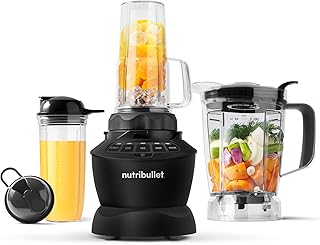
NutriBullet Blender Combo NBF50500
- Motor: 1,200 watts, a single published rating with no peak qualifier
- Pitcher: 64 oz (1.8 L) pitcher with lid and vented lid cap, BPA-free plastic
- Also in the box: tamper, 32 oz cup, 24 oz handled cup, and 2 to-go lids
- Blade: Easy-Twist Extractor Blade, stainless steel, with cyclonic action
- Controls: 3 speeds plus Pulse plus an Extract program, push-button controls
- Care: pitcher, cups, and lids are top-rack dishwasher safe; the blade is hand-wash only
- Size: 7.75 in deep x 8.07 in wide x 16.97 in high; the weight figure was not verified as a single settled number, so it is not stated here
- Warranty: 1-year limited warranty
The Combo leads this list because its circulation claim is written into the blade itself. The maker lists the Easy-Twist Extractor Blade as using cyclonic action, which is the cup-and-pitcher version of the vortex idea: the blade shape and the vessel walls work together to pull ingredients down and around in a fast circular rush, so frozen fruit and greens keep returning to the cutting edge instead of settling at the top. In the 64 oz pitcher that action has room to develop across a full batch, and the included tamper gives you a way to press a reluctant corner of the load back into the stream during the first seconds, when a thick mixture is still finding its motion.
The control layout supports that pacing well. Three speeds let you start a dense load low, let the vortex form, and then step up, while Pulse handles the stop-and-drop rhythm that frees ingredients clinging to the walls. The Extract program runs the cup side of the machine, and the 32 oz and 24 oz handled cups use the same extractor blade approach, so a single morning drink gets the same downward pull in miniature. The vented lid cap accommodates hot ingredients in the pitcher, which widens the machine beyond cold drinks into soups and sauces where steady circulation also matters for even texture. For a household that blends both big pitchers and grab-and-go cups, this is the most complete circulation package in the group.
Pros: Cyclonic action is a named, verified feature of the extractor blade, not a marketing guess. The 64 oz pitcher, tamper, and two cups cover batch and single-serve work in one box. Three speeds plus Pulse plus an Extract program give good control over how a load starts moving.
Cons: The blade is hand-wash only even though the pitcher, cups, and lids can go on the top rack. With only three speeds, fine gradual ramping is coarser than on the variable-dial machines below. Published weight figures disagree, so buyers who need an exact figure should confirm it with the maker.
Cleanblend Commercial Blender 2001
- Motor: 1,800 watts, 3 HP
- Pitcher: 64 oz BPA-free Tritan pitcher; tamper included
- Blade: 8-blade hardened stainless-steel assembly on a sealed ball bearing
- Drive: all-metal drive
- Controls: variable speed control plus Pulse
- Size: 8 in deep x 8 in wide x 19 in high; the weight figure conflicts between sources, so it is not stated here
- Warranty: 5-year full warranty
- Note: the pitcher is Tritan, not stainless steel; only the blade assembly is stainless steel
If the NutriBullet entry is about a blade designed to spin a load into a rush, the Cleanblend is about sustained force guided by hand. Its variable speed dial is the vortex tool here: you can roll the speed up slowly, watch the center of the load begin to dip and fold, and hold the speed at exactly the point where the whole pitcher is turning over without splashing thin liquid up the walls. That kind of fine, continuous control is something preset-driven machines rarely match, and with 1,800 watts and a 3 HP motor behind the dial, the machine keeps that circulation going through dense loads that would stall a weaker motor as the mixture thickens.
The hardware around the motor backs up the approach. The 8-blade hardened stainless-steel assembly presents a lot of cutting surface to the stream of food the vortex delivers, and the sealed ball bearing and all-metal drive suit a machine meant to run hard and often. The included tamper covers the loads where circulation needs help, such as thick purees and frozen mixtures with little free liquid. The maker positions this model as a commercial-style unit that can crush, blend, chop, grind, heat, puree, and liquify, effectively standing in for up to nine kitchen appliances, and its 64 oz Tritan pitcher is sized for that workload. At 19 in high it is a tall machine, so measure the space between counter and cabinets before committing to it.
Pros: The strongest motor figures in this group, paired with a true variable dial for careful vortex pacing. The 8-blade assembly and all-metal drive suit heavy, frequent use. A tamper is included, and the 5-year full warranty is the longest stated term among the pitcher models here.
Cons: There are no preset programs, so every blend is driven by hand at the dial. The 19 in height will not suit every counter. Sources conflict on the weight, so no settled figure can be given here.
Dash Chef Series Digital Blender
- Motor: 1,400 watts, 2.25 HP; one review source lists a blade speed of 35,000 RPM and a 240 mph tip speed
- Jar: 64 oz Tritan copolyester jar, described as virtually unbreakable, with a 2-part vented rubber lid
- Also in the box: custom tamper and recipe book
- Blade: 6-point commercial-grade Japanese stainless-steel blades
- Drive and safety: all-metal drive socket; auto shut-off on overload
- Controls: 10 speeds plus Pulse, plus 6 digital presets named Rinse, Puree, Soup, Smoothie, Crush, and Frozen
- Size: 8.75 in diameter footprint; 21.5 in tall with the 64 oz jar fitted; the weight figure was not verified, so it is not stated here
- Warranty: 1-year limited warranty on parts and a 7-year warranty on the motor
The Dash builds its vortex from the top of the speed range downward. Ten speeds is the widest manual ladder in this roundup, and that granularity matters for circulation: a load of ice and frozen fruit can be walked up through the middle speeds, each step drawing more of the jar into the downward stream, before the highest speeds finish the texture. The six named presets, Rinse, Puree, Soup, Smoothie, Crush, and Frozen, plus Pulse, give the same ramping in automatic form for cooks who would rather press one button and let the machine manage the pace. Either way, the 6-point blade gives the circulating load plenty of edges to meet as it passes through the center.
The custom tamper in the box is the other half of the story, and it lifts the Dash above preset-only rivals for thick work. A frozen blend that climbs the walls and stalls can be guided back down while the motor runs, which restarts the vortex instead of forcing you to stop, open the lid, and stir by hand. The 64 oz Tritan jar is generous, the vented lid suits hot soup work, and the overload shut-off guards the motor when a dense load binds. One caution is size: at 21.5 in tall with the jar fitted, this blender does not fit under standard kitchen cabinets, per one review source, so it needs open counter space or storage elsewhere. It is also an older design that is still sold today, worth knowing if the newest control layouts matter to you.
Pros: Ten speeds plus Pulse offer the finest manual control over how a vortex builds in this group. Six named presets cover the common tasks, including a Rinse cycle. The included custom tamper handles thick loads that stall circulation, and the motor warranty runs 7 years.
Cons: At 21.5 in tall it will not fit under standard cabinets. The weight was not verified, so no figure is stated. The design has been sold for many years, and one review notes a wear point in the pitcher retainer nut over long use.
Ninja Professional Plus Kitchen System BN801
- Motor: 1,400 peak watts; one review source lists 1,200 watts operating
- Pitcher: 72 oz Total Crushing Pitcher, BPA-free plastic, with a 64 oz maximum liquid capacity
- Also in the box: 64 oz (8-cup) Precision Processor Bowl with chopping and dough blades, and two 24 oz single-serve cups with spout lids
- Blades: Total Crushing Blades for the pitcher and Pro Extractor Blades for the cups, stainless steel
- Controls: 5 Auto-iQ programs, named Smoothies, Frozen Drinks, Nutrient Extractions, Chopped Mixtures, and Dough, plus 4 manual programs and 3 speeds
- Dough work: the maker lists the dough blade as mixing up to 2 lb of dough in as little as 30 seconds
- Care: parts are dishwasher safe, listed as top rack by one review source
- Warranty, dimensions, and weight: none of these figures were stated on the pages opened for the research file, so none are presented here as settled facts
The BN801 creates its vortex with height. The Total Crushing blade assembly is a stacked column of blades rising through the pitcher, so instead of cutting only at the base and relying entirely on the downward stream to deliver food, it cuts at several levels as ingredients circulate. Ice and frozen fruit falling through the center meet blades on the way down, and the tall 72 oz pitcher gives that cycle room to run across a big batch. For drinks work, this is a forgiving design: even when the vortex is still forming in the first seconds, the upper blades are already reducing the load, which helps the whole pitcher settle into a steady turnover faster.
The system around the pitcher is the broadest in this roundup. The 8-cup Precision Processor Bowl with chopping and dough blades takes on work that is not about circulation at all, from chopped mixtures to dough, and the two 24 oz cups with Pro Extractor Blades handle single drinks with the pull-down action extractor blades are known for. Five Auto-iQ programs run the main tasks in timed patterns of pulsing and blending, which suits cooks who want the machine to manage the rhythm. The honest gaps are in the paperwork rather than the hardware: the research file found no stated warranty term, dimensions, or weight for this model on the pages opened, so shoppers who need those figures should get them from the maker directly before buying.
Pros: The stacked blade column cuts at multiple heights, so circulation and crushing reinforce each other in the 72 oz pitcher. The processor bowl and dough blade make it the most versatile system here. Two single-serve cups with extractor blades are included for small drinks.
Cons: No warranty term, dimensions, or weight were stated in the verified sources, which complicates comparison shopping. There is no tamper, so very thick pitcher loads rely on the blade column and program patterns alone. The full system has many parts to store.
Ninja Professional Plus Blender DUO BN751
- Motor: 1,400 peak watts; two review sources list 1,200 watts operating; 120 V
- Pitcher: 72 oz Total Crushing Pitcher, BPA-free plastic, with a 64 oz maximum liquid capacity
- Also in the box: two 24 oz single-serve cups with spout lids
- Blades: Total Crushing Blades, stacked, for the pitcher; Pro Extractor Blades assembly for the cups; stainless steel
- Controls: 3 Auto-iQ programs, named Smoothie, Frozen Drink, and Nutrient Extraction, plus 3 manual speeds and Pulse
- Warranty: 1-year limited warranty
- Dimensions and weight: the figures in the research file rest on a single source, so they are not stated here
Think of the BN751 as the BN801 with the focus narrowed back onto blending itself. The pitcher, the stacked Total Crushing Blades, and the peak power figure are the same, so the circulation story is the same: a tall column of blades working inside a 72 oz pitcher, pulling a big drinks load into a rolling turnover and cutting it at several heights as it passes. Where the BN801 spreads its attention across a processor bowl and dough work, the BN751 keeps three Auto-iQ programs aimed squarely at drinks, Smoothie, Frozen Drink, and Nutrient Extraction, backed by three manual speeds and Pulse for direct manual control.
That narrower focus has practical advantages. Fewer attachments mean less storage and a simpler counter routine, and the two 24 oz cups still cover the weekday single-drink habit with the Pro Extractor Blades assembly, which draws cup contents down through the blades in the familiar extractor pattern. The three manual speeds are enough for the classic vortex routine of starting low, letting the pitcher gather itself, and stepping up to finish. What you give up against the BN801 is the chopping and dough capacity, and against the tamper-equipped models you give up a tool for the thickest pitcher loads, where a dense frozen mixture can still need a pause and a scrape down the walls. As a large-batch drinks machine with a clear, verified spec sheet and a stated 1-year limited warranty, it is a straightforward pick.
Pros: The same stacked-blade, 72 oz pitcher circulation as the larger system, in a simpler package. Three Auto-iQ drink programs plus three manual speeds and Pulse cover both automatic and manual blending. The warranty term is stated, and two 24 oz cups are included.
Cons: No tamper is included for very thick pitcher loads. There is no processor bowl, so chopping and dough work are out of scope. Dimensions and weight rest on a single source and cannot be confirmed here.
KitchenAid 5-Speed Diamond Blender KSB1575
- Motor: 0.9 HP, listed at 550 watts
- Pitcher: 60 oz BPA-free Diamond-shaped pitcher, described as shatter-, scratch-, and stain-resistant, and dishwasher safe
- Base: die-cast metal base with a steel-reinforced coupler
- Blade: patented stainless-steel Diamond blade system, built in rather than removable, per one source
- Controls: 5 speeds plus Crush Ice and Pulse at all speeds; white LED control panel
- Motor management: Intelli-Speed Motor Control and a Soft Start feature
- Warranty and dimensions: no warranty term was verified in the research file, and dimension figures conflict between sources, so neither is stated here as settled
The KitchenAid entry is the clearest argument in this roundup that a vortex is a shape before it is a number. Its 60 oz pitcher is formed as a diamond, with angled faces that meet in edges running down the jar. Those angles interrupt the flat circular ride that lets ingredients spin untouched around a round wall; instead, the moving load keeps striking a new face and folding back toward the center and the blades. On paper this is the least powerful motor in the group at 0.9 HP and 550 watts, yet the pitcher geometry does circulation work that stronger motors in plainer jars have to do by force alone. For daily smoothies, sauces, and crushed ice drinks at household volumes, that trade is a sensible one.
The control features are aimed at keeping the fold going smoothly. Intelli-Speed Motor Control works to hold the chosen speed as the load changes, which matters mid-blend when a vortex deepens and resistance shifts. Soft Start brings the blades up gradually at the start, drawing ingredients in rather than flinging them up the walls before circulation begins, and Pulse is available at all speeds alongside a dedicated Crush Ice setting across the five-speed panel. The die-cast metal base and steel-reinforced coupler give the machine a planted feel while it works. The trade-offs are real: there is no tamper, the built-in blade cannot be removed for the kind of deep cleaning some owners prefer, and thick, low-liquid loads will test a motor of this size more than the bigger machines above it.
Pros: The diamond-shaped pitcher folds ingredients toward the blades by design, supporting a strong vortex without relying on motor force alone. Soft Start and Intelli-Speed help circulation begin gently and hold steady. The pitcher is dishwasher safe, and the metal base feels substantial.
Cons: At 0.9 HP and 550 watts it is the least powerful model here, so very dense loads take longer and may need added liquid. No tamper is included. The blade is built in rather than removable, and no warranty term was verified in the sources.
Ninja Foodi TWISTi High-Speed Blender DUO SS151
- Motor: 1,600 peak watts; one review source lists 1,100 watts running; smartTORQUE motor
- Pitcher: 34 oz high-speed pitcher with a built-in Twist Tamper and drizzle cap
- Also in the box: 24 oz single-serve cup, 18 oz nutrient extraction cup, and two spout lids
- Blade: Hybrid Edge blades, stainless steel
- Controls: 5 Auto-iQ programs, named Extract, Smoothie, Frozen, Spread, and Bowl, plus Pulse
- Warranty, dimensions, and weight: no warranty term was verified in the research file, and the dimension and weight figures rest on a single source, so they are not stated here
The TWISTi is the specialist at the end of this list, and it should be read as one. Its pitcher holds 34 oz, which is a personal and small-batch vessel, never a large family pitcher, and everything about the design serves thick blends at that scale. The signature feature is the Twist Tamper built into the pitcher: while the machine runs, you rotate the tamper and its paddles push thick ingredients off the walls and back down into the Hybrid Edge blades. In a small, dense load, that mechanical push replaces the vortex that a thin load would form on its own, and it is exactly what smoothie bowls, frozen spreads, and nut mixtures need, since those mixtures are too thick to circulate unaided in any jar.
The smartTORQUE motor is built to keep turning under that kind of resistance rather than stalling when the load binds, and its 1,600 peak watt figure is the highest peak rating in this roundup, applied to the smallest pitcher. The five Auto-iQ programs, Extract, Smoothie, Frozen, Spread, and Bowl, map directly onto the thick-blend work the machine is for, and the drizzle cap lets you add liquid or oil mid-blend to loosen a mixture just enough for the tamper and blades to take over. The 24 oz and 18 oz cups extend it into drinks and extractions. Just keep the role clear: households blending big pitchers of drinks for several people should choose one of the 64 or 72 oz models above, while anyone whose main goal is thick bowls and spreads in small batches will find this the most purpose-built tool here.
Pros: The built-in Twist Tamper works during blending, pushing thick loads back into the blades in a way no loose-tamper or tamper-free design matches at this size. The smartTORQUE motor and 1,600 peak watts suit dense, resistant mixtures. Five Auto-iQ programs are aimed at bowls, spreads, and frozen blends.
Cons: The 34 oz pitcher is small and is not a family-size vessel. No warranty term was verified in the sources. Beyond the built-in tamper work, it offers no manual speed dial for gradual ramping.
Buying Guide
Start with the load you blend most, because the right vortex design follows from it. Thin and medium loads, such as drinks with plenty of liquid, frozen fruit smoothies, and sauces, circulate willingly in almost any of these jars, and the choice turns on batch size and controls. Thick loads are the real dividing line. Spoonable bowls, dense spreads, and frozen mixtures with little liquid need either a tamper you can work during the blend, as the Cleanblend, Dash, and NutriBullet Combo provide, or the built-in rotating tamper of the TWISTi. If thick blends are your main work and you choose a tamper-free machine, expect to stop and scrape, and expect to add liquid more often.
Next, read jar shape as carefully as motor size. A stacked blade column, like the Total Crushing design in both big Ninja pitchers, cuts the circulating stream at several heights and forgives a load that is still settling. Angled walls, like the diamond faces of the KitchenAid pitcher, fold the stream back toward the center by geometry. A conventional round or square jar with a base blade, like the Cleanblend and Dash, leans hardest on speed control and tamper work, and rewards a cook who likes to drive the blend by hand. None of these approaches is wrong; they simply ask different things of you, and the honest question is whether you want to manage circulation or have the hardware manage it.
Speed control is the third decision. Variable dials, on the Cleanblend, allow the finest pacing, rolling a load from rest into a full turnover without steps. Multi-speed panels, from three speeds on the NutriBullet Combo and BN751 to five on the KitchenAid and ten on the Dash, give repeatable steps that are easy to return to. Preset programs, including the Auto-iQ sets on the Ninja models and the six named presets on the Dash, manage the pattern of bursts and ramps for you, which is genuinely useful at busy breakfast hours. Pulse deserves a mention in every case: it is the simplest vortex tool of all, dropping a settled load back onto the blades in short bursts.
Size and storage come fourth. The 72 oz Ninja pitchers and the 64 oz pitchers on the NutriBullet Combo, Cleanblend, and Dash suit households blending for several people, while the 60 oz KitchenAid sits close behind for daily family use. The 34 oz TWISTi pitcher is a deliberate small-batch tool. Height matters as much as volume: the Cleanblend stands 19 in high and the Dash 21.5 in with its jar, so both need open counter or cupboard planning, while the NutriBullet Combo, at 16.97 in high, is the easier fit of the large machines listed with verified dimensions. Where dimensions or weight were not verified for a model, that gap is noted in its section rather than filled with a guess.
Finally, weigh the ownership details that the verified files do state. Warranty terms given here range from the Cleanblend's 5-year full warranty and the Dash's 7-year motor warranty to the 1-year limited terms on the NutriBullet Combo and BN751, with a few models carrying no verified term at all, which is worth resolving with the maker before purchase. Cleaning differs too: the NutriBullet Combo asks for hand washing of its blade while its pitcher and cups go on the top rack, the KitchenAid pitcher is dishwasher safe with a built-in blade, and the Ninja systems list dishwasher-safe parts. None of these details creates a vortex, but all of them decide whether the machine that blends well also lives well in your kitchen.
FAQ
What exactly is a vortex in a blender?
It is the funnel-shaped dip that forms at the center of a moving blend when circulation is working well. Ingredients travel down the middle toward the blades, get cut, move outward and up the walls, and fold back down again in a continuous loop. When that loop holds, the whole jar is being processed, not just the layer near the blades. When it breaks down, food rides the wall or sits on top untouched, and texture comes out uneven.
Which features create a stronger vortex?
Verified features that help include jar walls angled to fold food inward, like the diamond-shaped KitchenAid pitcher, blade assemblies that cut at more than one height, like the stacked Total Crushing Blades in the large Ninja pitchers, extractor blades described by the maker as using cyclonic action, like the NutriBullet Combo blade, and motors strong enough to keep the loop moving as a load thickens. Speed control that lets a blend start gently and build, and a tamper for thick loads, both support the same loop.
Do I need a tamper for a good vortex?
For thin and medium loads, usually not, because the mixture itself carries ingredients back down. For thick loads with little free liquid, a tamper is often the difference between a blend that circulates and one that stalls with an air pocket around the blades. In this group, the Cleanblend, Dash, and NutriBullet Combo include a loose tamper, and the Ninja TWISTi builds a rotating tamper into its pitcher for exactly that thick work.
Why does my blend sometimes stall even in a powerful blender?
Power turns the blades, but circulation moves the food, and the two are not the same. A dense load can bridge over the blades and leave a hollow space at the base, especially when it is loaded dry on top of wet or filled past the point where the jar can turn over. Starting at a lower speed, adding ingredients in a sensible order with liquid near the blades, using Pulse to drop the load, and working a tamper where one is provided all restart the loop more reliably than simply choosing the highest speed.
Is a bigger pitcher always better for circulation?
No. A large pitcher gives a vortex room to form for big batches, but a small load in a large jar can spread thin across the base and circulate poorly. The 34 oz TWISTi pitcher exists for the opposite case, keeping a small, thick load concentrated over its blades with tamper help. Match pitcher size to your usual batch: the 64 and 72 oz models here for family volumes, the 60 oz KitchenAid for daily mid-size work, and the TWISTi for small dense blends.
Can these blenders handle hot ingredients?
Two of the models here carry verified notes on the point. The NutriBullet Combo has a vented lid that accommodates hot ingredients in its pitcher, and the Dash jar has a 2-part vented rubber lid of the kind used for soup work, with a Soup preset among its six programs. For any model, follow the maker guidance for your exact machine on hot liquids, fill levels, and venting, since those instructions differ between designs and were not stated for every model in the research files.
Conclusion
A good vortex is not a mystery feature or a slogan. It is the visible result of a jar, a blade, and a motor working together to keep the whole load moving through the cutting zone, and each machine in this roundup builds that motion in its own verified way. The NutriBullet Blender Combo NBF50500 leads on the strength of a blade whose maker names cyclonic action outright, wrapped in a flexible pitcher-and-cup system with a tamper in the box. The Cleanblend answers with force and a variable dial, the Dash with ten speeds, six presets, and its own tamper, and the two large Ninja systems with stacked blades that cut the circulating stream at several heights. The KitchenAid shows how much jar shape alone can fold a load, and the TWISTi closes the list as the small, tamper-driven specialist for thick bowls and spreads.
Choose by the food you actually blend. Big drinks batches point to the 72 oz Ninja pitchers or the 64 oz jars. Cooks who enjoy pacing a blend by hand will value the Cleanblend dial and the Dash speed ladder. Daily mid-size blending with minimal fuss suits the KitchenAid and its folding pitcher walls. Thick small batches belong to the TWISTi. Whichever direction you go, judge the machine by the loop it can sustain in the jar, because that steady downward pull, returning every last piece to the blades, is what smooth and even blending is made of.
Related guides
More from Amazon
Programs that pair well with the guide above. Offers and eligibility are set by Amazon and may change.
Free shipping on eligible items, Prime Video and more. Eligible new members can start with a free trial.
Start a Prime free trialAudiobooks and podcasts to listen to on the go. Eligible new members can start with a free trial.
Try Audible freeAd-free music streaming. Eligible new subscribers can start with a free trial.
Try Music Unlimited freeA free business account with business pricing and bulk-buying tools for work, shop or home office.
Create a business accountAs an Amazon Associate we earn from qualifying purchases.
More ways to save in your kitchen
Programs that pair well with the guide above. Offers and eligibility are set by Amazon and may change.
Fast, free shipping on eligible items, plus Prime Video and more. Eligible new members can start with a free trial.
Start a Prime free trialSet up recurring deliveries of everyday items on eligible products. Terms and savings are set by Amazon.
Explore Subscribe & SaveRead from a huge library of eBooks, including how-to guides and cookbooks. Eligible new members can start with a free trial.
Try Kindle UnlimitedAudiobooks and podcasts for the commute, the garage or the kitchen. Eligible new members can start with a free trial.
Try Audible freeAs an Amazon Associate we earn from qualifying purchases. Using these links costs you nothing extra.



Write Your Review
No reviews yet. Be the first to share your experience!